 lunabia
Baby sleep at 2 months: what is normal
At two months your baby sleeps a lot, but rarely in one stretch. Here is why a fixed rhythm is not possible yet and what you can still do.
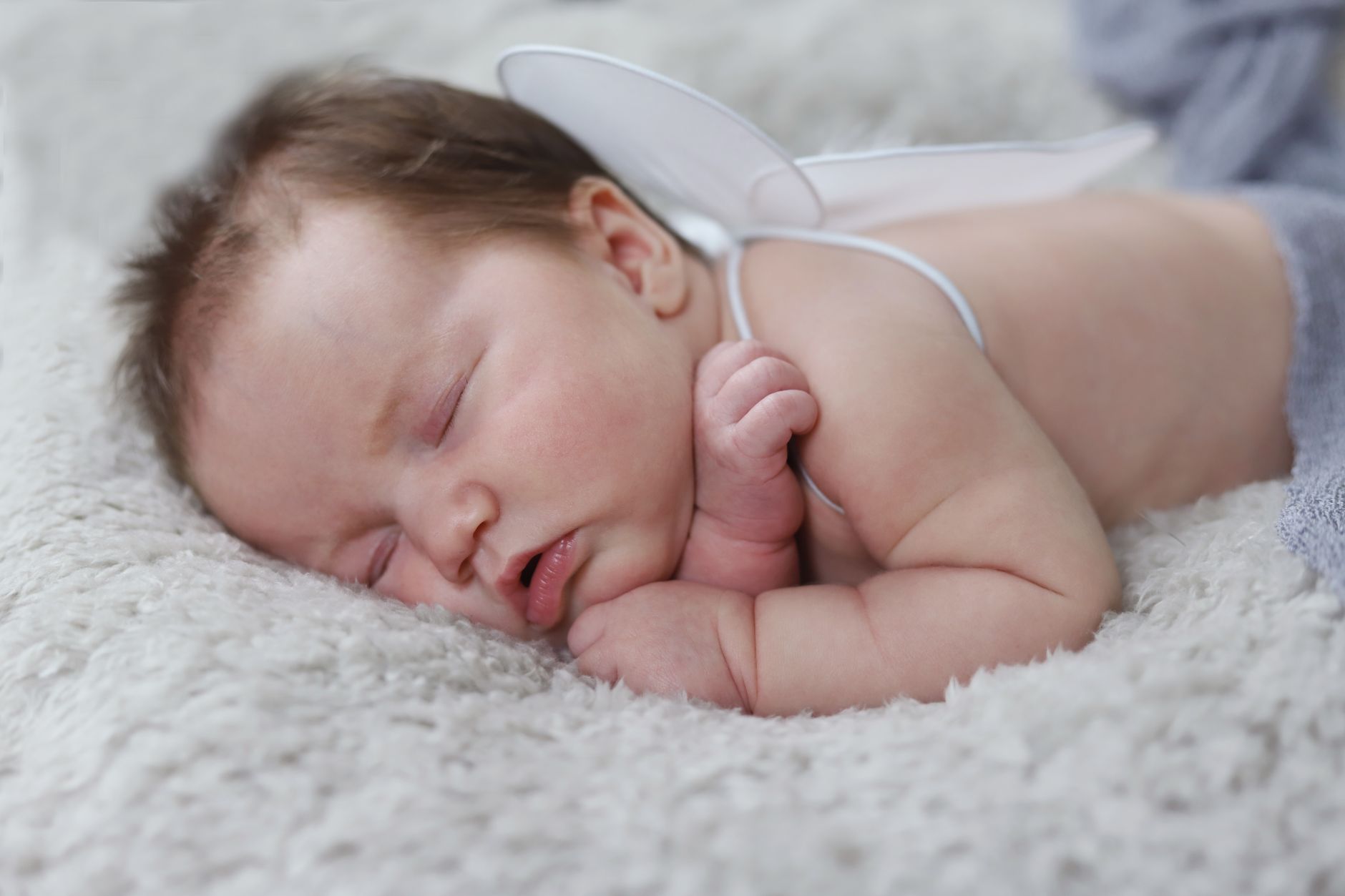
It is half past three, your baby is awake for the fourth time, and somewhere in your head sits a sentence from someone you know: "Mine has been sleeping through for weeks." That sentence is almost never true the way it is said. And right now it does not help you at all.
At two months, baby sleep is not a rhythm yet. It is a collection of portions. This is not a phase you are handling badly. It is simply how a brain works at this age.
How much a two month old sleeps
The usual figures are around 14 to 17 hours in 24 hours. Some babies manage on 13, others need 18. Both can be completely normal, as long as your baby seems content when awake, feeds and gains weight.
More important than the total is how those hours are spread out. At two months there are usually four to six sleep phases across the day and night, with awake times of about one to one and a half hours in between. The longest phase often falls at night and lasts three to five hours for many babies. For others it is two. That is not a fault either.
What you almost never get: reliability. A day with four long naps is followed by a day with eight short ones. That variation is the normal state, not the exception.
Why there is no rhythm yet
The reason lies in the internal clock. Babies are born without a stable day and night pattern. In the first weeks, the body barely produces melatonin, the hormone that brings on tiredness in the evening. From around eight to twelve weeks this slowly starts. It is a step in biological maturing, not the result of parenting.
Then there is sleep itself. Babies spend far more time in light, active sleep than adults do. In this phase they twitch, make noises, briefly open their eyes. They are easy to wake. That is functional: a newborn who sleeps too deeply does not speak up when it is hungry or when breathing falters. Light sleep is a form of protection.
And then there is the stomach. A tummy the size of a hen's egg does not hold enough for eight hours. A two month old usually feeds every two to four hours, at night often about as frequently as during the day. Breast milk is digested faster than formula, so breastfed babies wake a little more often on average. That is not a sign that your milk is not enough.
So if you are waiting for a plan to settle in at two months: it comes later. For most babies, sleep shifts noticeably towards the night between the third and sixth month. For some it takes until the second year before nights are unbroken. Both are within the normal range.
What you can influence now
You cannot give your baby a rhythm. But you can give the cues from which your baby builds one.
The strongest cue is light. Daylight during the day, including for naps. No darkened room, no whispering. In the evening and at night, the opposite: dim, quiet, little conversation. When breastfeeding or bottle feeding at night, use only as much light as you need. No nappy changes under the ceiling light if you can avoid it. This distinction works slowly, but it works.
The second point is awake windows. At two months many babies are tired again after 60 to 90 minutes awake. If that window is exceeded, your baby often does not tip into sleep but into overstimulation: fussy, restless, harder to settle. Watch the signals more than the clock. The gaze goes blank, movements get jerky, your baby turns its head away, yawns, rubs its face with a fist. From then on you have a short window of time.
The third point is repetition. Always the same short sequence before the longer night sleep: nappy change, sleepsuit, breast or bottle, dim light. Not because your baby understands it, but because patterns sink in over time. Five minutes is enough.
What does not work: cutting daytime sleep so the night gets better. Overtired babies fall asleep less easily and wake more often. This is the most common well meant misconception at this age.
Safe sleep
The recommendations are clear and they do not change: on the back, in their own cot in the parents' bedroom, on a firm mattress, in a sleeping bag rather than under a blanket. No pillows, no cuddly toys, no cot bumpers. Not too warm, around 16 to 18 degrees in the bedroom. Smoke free.
If you breastfeed in bed and fall asleep, that happens to many parents. Talk to your midwife about how you can make it safe in your situation, rather than keeping it to yourself.
When to ask for help
Sleep on its own is rarely the signal. It becomes worth noting in combination:
- Your baby is hard to wake, drinks noticeably less than usual or seems floppy.
- Your baby sleeps almost continuously and skips feeds, even though they are only two months old.
- Your baby cries inconsolably for hours, differently from usual.
- Fever, unusual skin colour, breathing noises or pauses in breathing that worry you.
- Weight gain is not right at the check ups.
With acute signs, call the hospital or the paediatrician, at night too. For anything that just feels odd, your midwife is the right first port of call. "I do not know whether this matters" is a perfectly good reason to phone.
Looking at several days
A single night says almost nothing. The impression that "he does not sleep at all" often comes from remembering the bad nights and not the good ones.
That is why it helps to write down for a few days when your baby sleeps and for how long. Not to optimise it, but to see what is actually happening. Usually it adds up to more hours than it feels like. And you start to spot patterns: that the longest stretch almost always falls between 10 pm and 2 am, for example, or that the late afternoon is reliably unsettled. In Lunabia you log sleep and feeds with a few taps and see the daily total and the rough rhythm without doing the maths yourself.
An overview like that does not change the nights. But it changes how you make sense of them. And at two months, that is often the only lever you really have in your hands.
And you
The sentence nobody likes to hear at this age is still the most important one: your baby's sleep is not your project right now. Yours is.
Sleep during the day when you can. Accept help, even for two hours. If you are not breastfeeding, or if there is expressed milk, split the nights between you instead of both lying there half awake. And if the exhaustion tips into something else, into emptiness, irritability, constant anxiety: that is common and treatable. Tell your midwife or your doctor. Not only once it becomes unbearable.
FAQ
How long should a baby sleep in one stretch at 2 months?
For most babies at this age the longest sleep phase is three to five hours, often at night. Some manage only two hours in one stretch, and that is normal too. Sleeping through in the sense of eight hours is the exception at two months, not the rule.
When does a baby get a fixed sleep rhythm?
The internal clock starts to mature from around the third month; before that the body produces hardly any melatonin of its own. Between the third and sixth month, sleep shifts noticeably into the night for many babies. A really reliable rhythm often only settles in during the second half of the first year.
How many naps does a 2 month old take per day?
Usually there are four to six sleep phases spread over 24 hours, with awake times of about 60 to 90 minutes in between. The length of individual naps varies a lot, from 20 minutes to two hours. The pattern can change completely from one day to the next.
Should I wake my baby for a feed if they sleep for a long time at night?
As long as your baby is gaining weight well and drinking enough during the day, you usually do not need to interrupt a longer night stretch. For babies with poor weight gain or newborn jaundice it can be different. Check this with your midwife or paediatrician.
This text does not replace a visit to your doctor or midwife. If something hurts or worries you, call them, even at night.
All posts on this topic: Baby sleep month by month